
27 July 2026
How High Should You Hang a Chandelier Over a Dining Table?
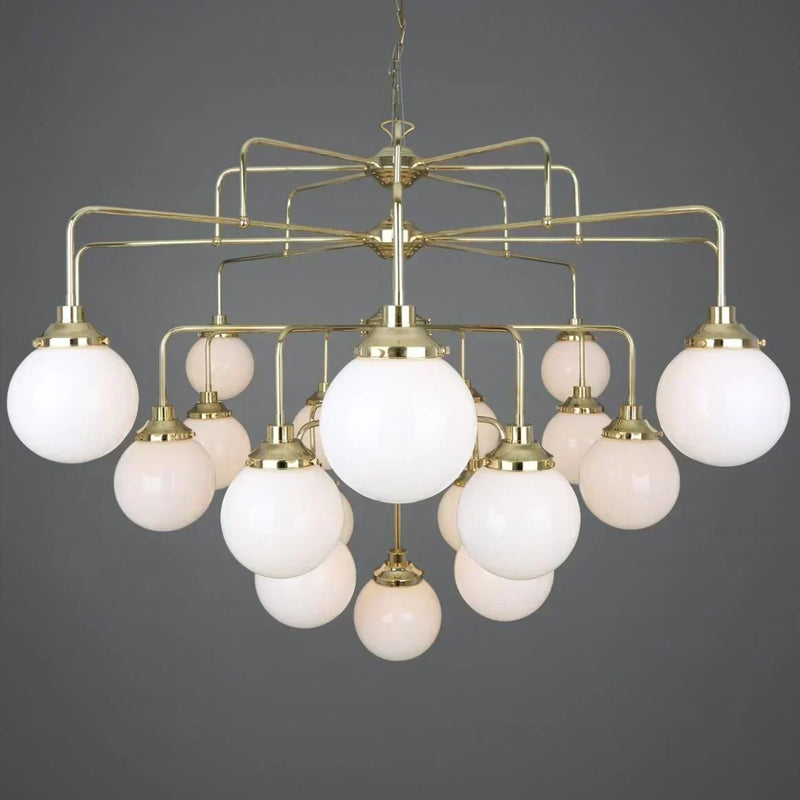
Hang the bottom of the chandelier 75–90cm above the surface of the table. That is the measurement that matters, and it holds for almost every dining room with a standard 2.4m ceiling.
Get the height wrong and everything else about the piece stops mattering: too low and people are talking round it, too high and the table sits in a pool of nothing. Everything below follows from that one measurement.
What you are measuring, and from where
Table top to the lowest point
Not floor to fitting, and not ceiling to fitting — table top to the lowest point of the chandelier. A dining table sits at roughly 75cm, so the bottom of the light lands somewhere around 150–165cm off the floor. Low enough to pool light on the table and make the room feel enclosed; high enough that nobody across the table disappears behind it.
The lowest point is whatever hangs lowest, which is not always the body of the fitting. On a tiered piece it may be the bottom shade; on a glass chandelier it may be a drop or a finial. Measure to the part that would touch a tall vase, not to the part the catalogue photographs.
Sit down before you decide
The test is not how the chandelier looks when you walk in. Sit at the table and look across it. If the bottom of the fitting cuts the line between you and the person opposite, it is too low, whatever the tape measure says.
It is also why a dining light hangs lower than one anywhere else. Our guide to pendant size in a hallway keeps the bottom of the fitting at least 2.1m off the floor, because people walk underneath it. Over a table, nobody does.
Adjusting for your ceiling
Adding height for a taller room
The 75–90cm range assumes a 2.4m ceiling. The convention for a taller room is to raise the fitting by roughly 7.5cm for every additional 30cm of ceiling. A 3m ceiling is 60cm more than standard, so that puts the chandelier around 90–105cm above the table.
A lower ceiling works the other way than people expect. You still raise the fitting, because the height has to come from somewhere: keep to the top of the range, nearer 90cm, and take the space out of the drop rather than out of the clearance.
Ceiling height decides which pieces are possible at all
A fitting is not just its drop — the body has height of its own, and that height is subtracted from your room before anything hangs.
The Mullan Rome stands 119cm tall before you add any suspension — four tiers of glass globes on solid brass arms, hand-assembled to order in Ireland. In a 2.4m room there is nowhere for it to go. Over a long table in a double-height hall, it is the piece the room is arranged around.
At the other end, a shallow fitting buys back the height a low ceiling does not have. The Quintiesse Rene drum is 26.8cm tall, less than a quarter of the Rome, with pressed glass discs layered around a distressed brass band so the light passes through several of them before it reaches the room. In a house with 2.3m ceilings, that depth is the whole decision.
Below about 2.3m, a hanging fitting may not be the right answer at all. A flush or semi-flush ceiling light gives you the same light over the table without the clearance problem, and it is the sensible choice in a room that cannot spare the height.
Measure the ceiling first, then choose the chandelier. It is the opposite of how most people shop, and it saves returning a piece that was never going to fit.
Getting the width right
Half to two-thirds of the table
Height is only half of it. A chandelier hung at exactly 80cm can still sit badly in a room if the proportions are off. The convention is to size the fitting at roughly half to two-thirds the width of the table. It is a rule of thumb rather than a law, but it is a reliable one.
If the piece is wider than the table, it stops reading as a dining light and starts reading as an obstacle.
What that looks like in real numbers
A 180cm table — a comfortable six-seater — wants something around 90–120cm across. The Sawgrass at 83.8cm sits just under that and suits a slightly narrower table; its metal blades cup each opal shade rather than sitting below it, so it reads as grass rather than as a frame. The Rene drum at 74.7cm is smaller again, and better over a round table or a four-seater.
The Rome measures 158cm in diameter, which asks for a table nearer 3m and a room with the volume to carry it.
Round tables are simpler: roughly half the table's diameter is a good starting point for the fitting's.
Long tables: one fitting, two, or a linear piece
Over about 240cm, a single central chandelier struggles. It either leaves the ends of the table dim or has to be so large that it dominates the room.
Two smaller fittings spaced evenly along the table usually work better — more even light, and neither piece has to be enormous. Space them so each sits over a third of the table's length rather than at the extreme ends.
The third option is a linear piece, built for exactly this shape. The Nottingham linear pendant runs 110.5cm, six amber glass orbs held at their widest point by a metal band, so the light falls warm down the length of the table from a single fixing. One ceiling point instead of two, which matters if the wiring is already in.
Centre it on the table, not the room
Dining tables are rarely dead-centre in a room, and the chandelier should follow the table. A light centred on the room but off-centre over the table is noticeable from every seat, and there is no fixing it afterwards without making good the ceiling. Mark the table's centre point before the electrician arrives, and mark it on the ceiling, not the floor.
If the table might move — an extending table, or a room you are still working out — say so before the ceiling rose goes in. Moving a fixing afterwards means making good the ceiling.
Weight, fixing and the electrician
Larger chandeliers are heavy, and the weight does not track the size in the way you would expect. The Rome weighs around 34kg. The Rene drum, which is smaller and much shallower, still comes in at 19.3kg — a fitting that looks modest can be heavier than one that looks grand.
Any of these needs a secure fixing into a joist or a properly rated ceiling plate. All are earthed Class I fittings, so a qualified electrician should handle the mounting and the connection. It is worth having them confirm the ceiling can take the load when you book them, rather than leaving it to the day of installation.
The light itself
Warm bulbs, and a dimmer
Warm bulbs, always, and a dimmer if you can. Dining light wants to fall away as the evening goes on, from bright enough to serve by to something low and quiet over coffee. Check the fitting is dimmable and pair it with compatible LEDs on a trailing-edge dimmer.
Bulb count matters more than wattage. The Rome carries 21 E27 bulbs across its four tiers; the Sawgrass holds six E14. Twenty-one modest lamps give a different quality of light from six brighter ones, even at the same total output: more points of light, softer shadows on the table.
Clear glass or opal
Clear glass gives sparkle and shows the filament, which suits a decorative bulb and a room you want to feel lively. Opal diffuses, hides the lamp and spreads the light more evenly — kinder over a table where people sit for a long time. The Rome offers both; the Sawgrass uses opal throughout.
Choose the finish against the ceiling
A chandelier is the one fitting seen against the ceiling rather than the walls, and ceilings are no longer being left plain. Houzz UK searches for January to March 2026, set against the same months in 2025, show "wallpapered ceiling" up 88%, "exposed wooden beams" up 79% and "painted ceiling" up 31%.
If the ceiling is going dark, or papered, or stripped back to beams, choose the finish against that. Antique brass settles into a dark ceiling; polished brass holds its own against beams; a painted ceiling will take either, depending on the colour.
Common questions
How high should a chandelier hang above a dining table?
75–90cm from the table top to the lowest point of the fitting, in a room with a 2.4m ceiling. Add about 7.5cm for every extra 30cm of ceiling height.
What if my ceiling is lower than 2.4m?
Keep to the top of the range, around 90cm, and choose a shallow fitting. A piece 25–30cm tall leaves room to hang properly where one over a metre tall does not.
How wide should the chandelier be?
Half to two-thirds the width of the table. For a round table, about half the table's diameter.
What about a very long table?
Over roughly 240cm, use two fittings spaced along the table or a single linear piece built for the shape. One central chandelier large enough to light a long table usually overwhelms the room.
Does it have to be centred on the room?
No — centre it on the table. A light squared to the room rather than the table is noticeable from every seat.
Can I fit a chandelier myself?
No. These are earthed Class I fittings, often 10–35kg, and they need a fixing rated for the load. It is work for a qualified electrician, who should also check the ceiling can take the load.
Where to start
Measure the ceiling, then the table, in that order, and the choice narrows itself. Browse the full range of chandeliers, or our pendant lights if a single fitting suits the room better. Pieces built to your specification sit in made to order.
If you are planning the whole room rather than one fitting, our guide to lighting layers covers how the pieces work together, and pendant height over a kitchen island covers the same measurement problem in the next room along.